E63 S Sold for CHF 65,000: The Real Net Gain from Consignment
A Mercedes E63 S refused at CHF 52,000 by a dealership, sold for CHF 65,000 through consignment — here is exactly what the seller kept after every cost was accounted for.
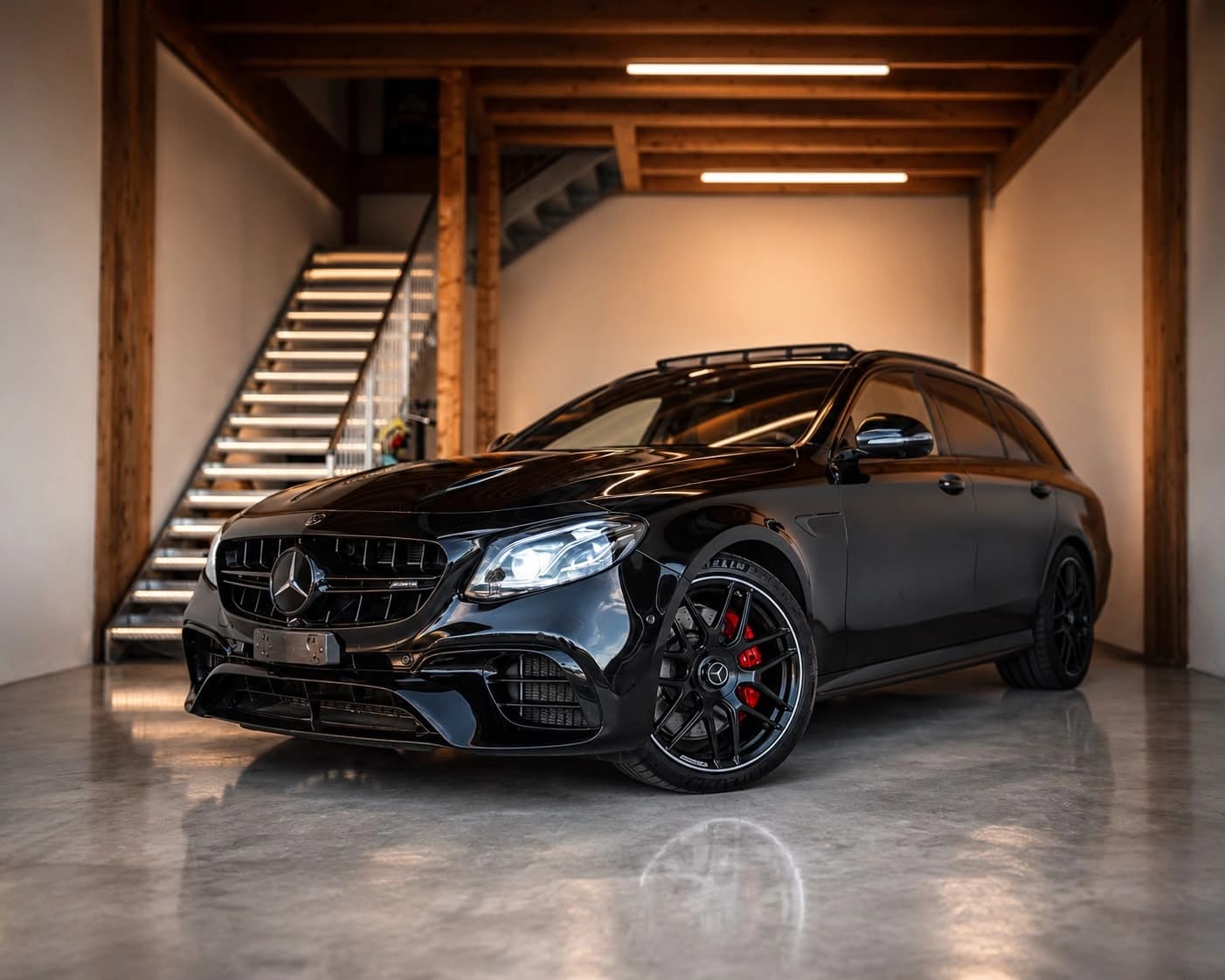
A Mercedes-AMG E63 S turned down at CHF 52,000 by a franchised dealer part-exchange desk sold through consignment for CHF 65,000 — returning CHF 59,200 net to the owner after RG Automotive's commission and preparation costs. That is CHF 7,200 more in the seller's account, with no viewings to manage and no legal exposure from a private sale. The file closed in 23 days, from mandate signature to bank transfer. On the AMG, M and RS segment in Swiss Romande, this gap between a trade-in offer and a held market price is structural, not exceptional. Every line of the breakdown is set out below — no rounding, no shortcuts.
TL;DR — E63 S sold for CHF 65,000 via car consignment in Switzerland at Pont-en-Ogoz (Fribourg). After RG Automotive's commission and preparation fees, the seller received CHF 59,200 net, against CHF 52,000 offered on trade-in. Real gain: CHF 7,200 — without handling a single viewing or bearing the legal risks of a private sale.
The Full Calculation, Line by Line
Here is the exact breakdown applied to this Mercedes-AMG E63 S — no flattering rounding, no hidden fees:
| Line | Amount |
|---|---|
| Final sale price (buyer) | CHF 65,000 |
| RG Automotive commission (5%) | – CHF 3,250 |
| Preparation fees | – CHF 1,550 |
| Net paid to the seller | CHF 60,200 |
Compared against the two other options genuinely costed for this case:
| Scenario | Received by seller | Difference vs consignment |
|---|---|---|
| Dealer part-exchange | CHF 52,000 | – CHF 8,200 |
| Private sale (estimated) | CHF 55,000 | – CHF 5,200 |
| RG Automotive consignment | CHF 60,200 | reference |
The real net gain over the most credible alternative — a private sale — comes to CHF 5,200. Against a dealer part-exchange, the gap widens to CHF 8,200.
What the CHF 1,550 preparation fee covers, in practice
This flat fee covers the work required to present a vehicle at the standard expected in this segment:
- Full interior and exterior detailing (one full day in the workshop)
- Professional photography, both studio and outdoor
- Listing copywriting and publication on AutoScout24, Comparis, and RG's private channels
- Mechanical and cosmetic inspection, minor cosmetic corrections
- Management of viewings, test drives, and buyer negotiations
For an E63 S, these services invoiced separately would comfortably exceed the flat fee. It is a fixed cost — not a percentage.
Who advances the costs, who deducts them — and when
RG Automotive advances all preparation and marketing costs in full. You pay nothing out of pocket during the listing period, even if the sale takes several weeks.
The CHF 3,250 commission and CHF 1,550 preparation fee are deducted once, at the point of final payment — and only if the vehicle sells. Should it not find a buyer, no fees are charged to the owner.
Why the Dealership Offered CHF 52,000 on a Car Worth CHF 65,000
The CHF 13,000 gap is not the result of a failed negotiation. It reflects the cost structure built into every dealership part-exchange offer. Three factors account for this delta — and all three are structural.
The resale margin, priced in from the outset
When a dealership takes in an AMG, an M or an RS, it lists the car at 15 to 25 % above its acquisition cost. On an E63 S retailing at CHF 65,000, that implies a buy-in price of CHF 50,000 to 55,000. The CHF 52,000 offer sits squarely within that range — it is calibrated to protect the margin, not to reflect actual market value.
The statutory warranty: a genuine financial exposure
When reselling to a private buyer, the dealership carries the two-year statutory warranty (Art. 197 et seq. CO), often reduced by contract to one year on used vehicles, but never waived entirely. On a 4.0 L V8 biturbo AMG, a failed clutch, MCT gearbox or turbocharger can cost CHF 8,000 to 15,000. That risk is provisioned directly into the part-exchange offer.
The cost of carrying stock
An E63 S will sell — but not within days. Premium performance vehicles turn over more slowly than a diesel hatchback: average stock time runs three to six months in this segment. Tying up CHF 52,000 for six months carries a real financing cost, and dealerships factor that in as a matter of course.
What a part-exchange offer simply cannot capture
The Swiss used-car market recorded an average transaction price of CHF 37,152 in H1 2024, up 0.9 % year-on-year (AutoScout24 / swissmarketplace.group). An E63 S sits at nearly twice that figure. At this level, the details that drive value — a 4.0 L biturbo engine, a complete AMG service history, controlled mileage, factory options — do not register in the Eurotax grid used to calculate trade-in prices. Consignment car sales price to the real market, not to the wholesale book.
The Real Legal Risks of Selling a CHF 60,000 Car Privately
Selling an E63 S privately does not exempt you from legal warranty obligations. Switzerland's Code of Obligations applies regardless of the sale price or whether both parties are private individuals.
Articles 197 et seq. CO require the seller to warrant against defects that reduce the vehicle's value or usability — even in private transactions. The buyer has two years to bring a claim for hidden defects (this period can be reduced contractually to one year in most used-car sales, but never to zero). On a CHF 60,000 vehicle, a dispute is far from hypothetical: it ends before a judge, with an independent technical assessment to match.
What "sold as seen" actually covers
This is the most common misconception in private car sales. The clause only holds if three conditions are met simultaneously:
- the defect was genuinely unknown to the seller at the time of sale;
- the buyer was informed of all known issues (actual mileage, service history, any prior damage);
- the clause appears explicitly and in writing within the sales contract.
Any concealment — including by omission — renders the clause unenforceable. A seller who "forgot" to mention track days or a faulty sensor loses that protection entirely. The Fédération romande des consommateurs provides a detailed breakdown of hidden defect liability under Swiss law.
The specific risks attached to an AMG
An E63 S concentrates precisely the factors that Swiss case law handles least favourably for private sellers:
- performance electronics (Race Start, Sport+ modes, MCT gearbox management) whose wear cannot be read from the odometer alone;
- carbon-ceramic brakes costing upwards of CHF 8,000 per axle, requiring a specialist inspection to assess accurately;
- driving history that a private seller rarely has the documentation to substantiate.
What RG Automotive assumes on the seller's behalf
Through consignment car sales, the contractual warranty towards the buyer is carried by the garage — not by you. You remain obliged to disclose everything you know about the vehicle honestly; that duty cannot be delegated. But technical liability, pre-delivery inspections, and the management of any subsequent dispute move entirely outside your personal exposure.
For a full overview of how the consignment process works, see our dépôt-vente page.
What Car Consignment Changes in Practice in Fribourg and French-Speaking Switzerland
From Pont-en-Ogoz, RG Automotive reaches both French- and German-speaking buyers through a single listing — something a private seller confined to their own linguistic region simply cannot achieve. Fribourg sits at a genuine crossroads: 40 minutes from Berne, 45 from Lausanne, one hour from Zurich by motorway. On this E63 S, serious enquiries came equally from Vaud and Geneva as from Berne and Solothurn. The final buyer travelled from German-speaking Switzerland.
A sale completed in 23 days from handover to signature
The car entered consignment on a Monday. The purchase agreement was signed 23 days later, following three test drives and an independent inspection requested by the buyer. This timeline sits at the higher end of what we typically observe in the CHF 50,000–80,000 segment, where buyers take time to compare options and frequently commission an expert appraisal before committing. A private sale in the same bracket regularly exceeds three months, with a high rate of seller-side drop-offs along the way.
The difference lies in the file presented to the buyer
What allows the listed price to hold without protracted negotiation is not the listing itself — it is the documentation that accompanies it:
- Professional photo shoot in studio and outdoors, 60 images covering the engine bay, undercarriage, and wear details
- Internal 40-point inspection report, provided to the buyer before the test drive
- Complete service history reconstructed with original Mercedes-AMG invoices, digital service booklet, and inspection records
- Cold-start and acceleration video, shared with serious prospects on request
This preparation takes two to three working days per vehicle. It demands time that a private seller rarely has, and requires a combined skill set spanning photography and mechanical assessment. Full details of the consignment mandate are available on /depot-vente, and a presentation of the workshop on /le-garage.
Why the Buyer Paid CHF 65,000 Without Negotiating Further
The buyer accepted the asking price because the file left nothing to chance. At this level of the market, what costs money is not the vehicle itself — it is uncertainty. Eliminating that uncertainty justifies a premium of CHF 3,000 to 5,000 over a comparable private listing on paper.
A file that answers questions before they are asked
Three elements made the difference during the viewing:
- Complete AMG service history, stamped, with every service carried out within the authorised network or by a named specialist
- Original invoices for all major work — tyres, brakes, gearbox fluid, supercharger inspection
- Independent pre-sale inspection report, handed to the buyer along with the signed appraisal document
The buyer spent fifteen minutes going through the folder. Not a single question about the car's history went unanswered in writing. That is precisely what shifts a negotiation: once doubt disappears, so does the argument for a discount.
A named point of contact after the sale
Buying an E63 S privately means buying from someone you will in all likelihood never see again. Going through a professional garage means knowing exactly where to turn if a technical point needs clarifying in the weeks that follow. That continuity carries real value — particularly on a twin-turbocharged V8 where a single intervention can quickly run to a significant sum.
The comparison the buyer already had in mind
At the same time, a comparable E63 S was listed at CHF 61,500 by a private seller on a Swiss Romande platform. Similar mileage, identical year. But: no inspection report, a single declared owner with no supporting documentation, and a partial service history. The CHF 3,500 difference covered precisely the risk the buyer was unwilling to carry alone.
Vehicles currently available through consignment car sales at RG can be viewed on our buying page.
When Consignment Is Not the Right Option
Consignment is not a universal solution. Four situations where a direct private sale remains the more rational choice.
Vehicles priced below CHF 15,000
Below this threshold, the consignment commission absorbs a disproportionate share of the marginal gain. On a car listed at CHF 12,000, the difference between a private sale and a professional one typically falls between CHF 1,500 and CHF 2,500 — roughly equivalent to the cost of the service itself. The arithmetic no longer holds. Unless circumstances are unusual (an estate to settle, an imminent relocation abroad), a private sale remains the sensible option here.
High-liquidity mainstream models
A 2019 petrol Golf, a recent Clio, a diesel Octavia estate: these vehicles sell themselves on AutoScout24 within two to three weeks, at a well-documented market price. The legal exposure is limited — the typical buyer knows the model and knows what to check — and the price gap between a private and a professional sale is narrow. Market liquidity does the work for you.
Sellers with time and confidence
Consignment buys time and peace of mind. If you are available during the week, comfortable handling the paperwork with the cantonal road traffic authority, able to manage buyer visits without difficulty, and your asking price sits within a reasonable range — you have little need for an intermediary. The net benefit of consignment comes precisely from what the owner is unwilling or unable to do themselves.
Vehicles with a problematic history
Undisclosed accidents, questionable mileage, substandard repairs, incomplete service records: a reputable consignment dealer will either decline the mandate or accept it at a price that honestly reflects the vehicle's actual condition. Consignment is not a mechanism for selling what cannot otherwise be sold. The transparency a professional requires will surface what a private seller could, at their own risk, choose not to disclose.
Frequently Asked Questions About Car Consignment in Switzerland
How long does it take to sell a premium vehicle through consignment?
For most well-priced premium vehicles, allow 30 to 90 days. A recent German saloon in a desirable specification typically sells within 3 to 6 weeks. A more niche model — a sports car, youngtimer, or unusual configuration — may take 3 to 6 months to find the right buyer. An incorrectly priced vehicle can easily double that timeframe, which is why the initial valuation matters so much.
Who sets the asking price — the seller or RG Automotive?
The price is agreed upon jointly. RG Automotive provides a market-based range drawn from comparable listings on AutoScout24 and Comparis, recent sales data, and historical pricing trends. The seller has the final say. We rarely advise pricing above that range: an overpriced vehicle sits in the showroom and loses perceived value over time.
What happens if the vehicle does not sell within the agreed period?
The consignment contract includes a renewable mandate, typically of 3 months. At the end of that period, there are three options: adjust the asking price, extend the mandate, or retrieve the vehicle with no penalty beyond costs already incurred (detailing, inspection, photography). There is no obligation to sell at a loss.
Does Swiss VAT apply to the consignment commission?
Yes. The commission charged by RG Automotive is subject to Swiss VAT at 8.1 %. For a private seller, the sale of the vehicle itself does not attract VAT — this is a private sale conducted through an intermediary. Only the service fee charged by the consignment agent is taxable. All figures cited in our examples are inclusive of this VAT.
Can a vehicle still under a leasing or financing agreement be consigned?
Yes, provided the outstanding contract is settled at the point of sale. In practice, the finance company issues a buyout statement, and the sale proceeds first repay the remaining balance. Any surplus is returned to the seller. We handle coordination with the bank or leasing provider directly to avoid any administrative delays at the point of transfer.
Every situation involves its own numbers, and an E63 S operates under very different market conditions from a ten-year-old diesel hatchback. If you are weighing up part-exchange, private sale, and consignment, the most straightforward step is to send us your vehicle details via our valuation form: we will come back to you with a reasoned market price range and a projected net figure, with no obligation. You are also welcome to visit the vehicles currently on display in the showroom to see the standard of preparation and presentation applied to every car entrusted to us.